



Scaling today’s technologies consumes cash long before delivery and collection. To enable non-linear growth, the best companies of this decade will develop financing as a core competency by partnering proactively with lenders. This shifts financing from the factors of production to the units of production, where the units themselves serve as the underlying collateral. We call this shift the Arc of Financeability.
In the pre-AI software era, technology was defined by minimal capital expenditures and negative working capital. Customers paid annual contracts upfront and renewed on predictable cycles, creating a constant source of cash to fund growth. Low interest rates and near-zero marginal costs let companies scale even further with additional capital.
Now, developers of AI applications and services as well as frontier hardware technology must commit to compute capacity, integration work, hardware inventory, and specialized labor months before a project is accepted. A startup might prove itself with blue-chip customers, only to find momentum hampered by a lack of suitable growth capital. This can force companies to reduce their scope of ambition or seek relatively expensive equity.
Where working capital swallows cash, but project variables are known, there is a gap that can be funded at a lower level of risk (and thus a lower cost of capital). Yet lending has been limited to capped venture debt and asset-based financing against general equipment or receivables.[1]
For companies at the leading edge, credit should be seen as a growth catalyst and a critical input rather than a component of post-growth enterprises. Moving from a breakout to durable business requires building trust with customers, equity investors, AND lenders in parallel. Over time, we believe these financing relationships can form a real competitive advantage [Balance Sheet Era].
DEFINING THE UNIT OF PRODUCTION
To make their business legible to a lender, companies must establish a specific unit of production assignable to a customer. This is often a contract or a deployment. The buyer’s requirements may vary, but each unit should have at least a defined scope of work, a start date or delivery date, and a set of acceptance criteria. The cash outflows from each unit can be split three ways: upfront costs (hardware, deployment labor), recurring operating costs, and variable costs that swing with utilization or supply. Separating these unlocks creative ways to pull cash inflows forward to match the real timing of expenses. Normalizing these parameters across units allows lenders to underwrite unit-level returns.
Critically, this shifts the underwriting from the startup’s own balance sheet to the creditworthiness of its customers, whether a single large buyer or a diversified network of them. This financing structure also decouples risk from the resale value of specialized hardware.[2] As companies prove their capabilities to customers, their ability to raise non-dilutive growth capital is determined by:
1. Customer: customer’s credit attractiveness and the length and nature of the relationship
2. Operating history: demonstrated ability to deliver acceptable units over time
3. Contract terms: the specific provisions in each unit that make it more or less financeable, chiefly the tenor and payment structure (take-or-pay, minimum commitments, prepayments), the customer’s termination and cancellation rights, the acceptance criteria that define successful delivery, and the lender’s step-in rights and ability to claim the contractual cash flows in a downside scenario
Articulating these factors proactively helps lenders get comfortable with both the operating business and the paying customer. While venture capitalists are usually underwriting upside, creditors are principally concerned with capital preservation. Exceptional companies will translate their performance into credibility with both kinds of investors.
TRADING ECONOMIC POINTS FOR FINANCING
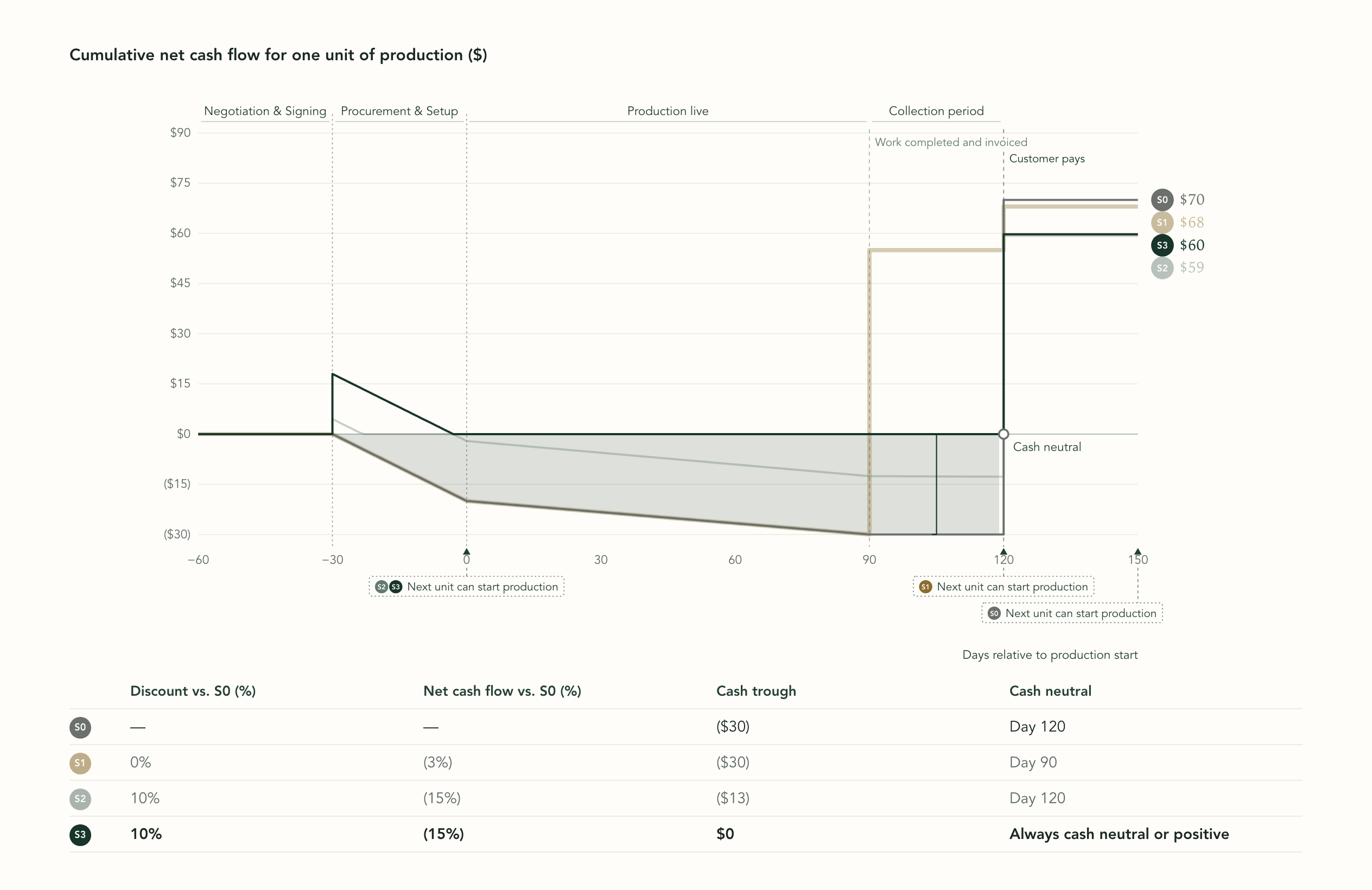
Suppose a breakout business is capital constrained and has the choice between the following options for one unit of production with the same delivery cost and acceptance criteria for a given creditworthy customer.
· Situation 0: $100 TCV, where the buyer pays at net-30 terms after delivery and has the option to terminate with one week of notice
· Situation 1: The same structure as Situation 0, but the company factors the invoice upon issuance
· Situation 2: $90 TCV, with a take-or-pay structure, a 5% prepayment, and lender financing at 15% loan-to-value at 15% cost of debt
· Situation 3: $90 TCV, with a take-or-pay structure, a 20% prepayment, and lender financing at 50% loan-to-value at 10% cost of debt
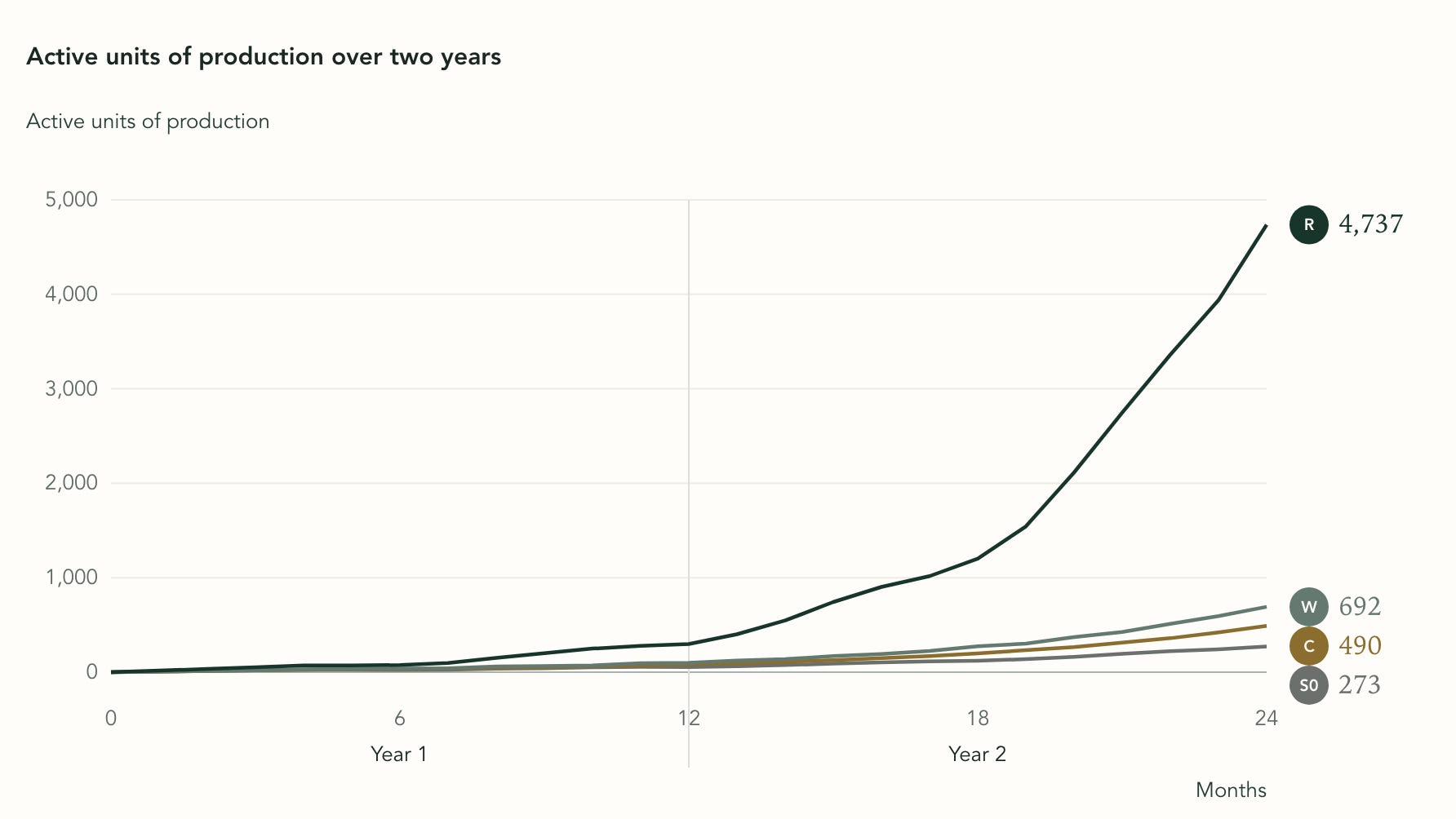
In this simplified example, Situation 0 earns the most overall, but risks the most company cash. In Situation 1, while invoice factoring pulls cash forward by 30 days and helps start relationships with lenders, pricing can be expensive for early-stage companies.[3] In Situations 2 and 3, exchanging a discount on list price for upfront cash and optimal contract structure allows the unit to become financeable. With prepayment and debt covering an increasing share of the upfront costs, the difference can be used to begin the next unit of production earlier. At scale, contracting under favorable terms recycles equity faster, allowing for multiple units to be produced concurrently. This accelerated growth enables companies to capture benefits that drive unit economic improvements critical to unlocking a sustainable venture scale business [Future Fundamentals].
View the full analysis here.
CRAWL, WALK, RUN – THE ARC OF FINANCEABILITY
In practice, a rising startup does not get to choose between these scenarios. It must earn its way to favorable contract terms and credit financing by proving execution. This is the basis of the crawl, walk, and run. In the ‘crawl’ phase, customer agreements often look like Situation 1. Cash is pulled forward with traditional receivables or equipment financing. Most of today’s frontier technology companies are here. As startups deliver for well-capitalized customers, they can ‘walk’ to economics like those of Situation 2. Credit can finance the subset of contracts with the highest counterparty quality and longest performance history. Founders should expect this to come at a fraction of contract value at fairly expensive terms. Lenders are likely to require supplier backstops and parent guarantees to limit losses. But by the ‘run’ phase, companies have an installed base of creditworthy customers and a growing backlog. Most of these contracts can be financed at an increasing percentage of contract value and a decreasing cost of capital. Parent guarantees could be lifted subject to tenor and performance. To graduate from crawl to walk to run, it is paramount for companies to communicate their operating performance well before needing credit. A relationship with history helps lenders to vouch to their investment committees with confidence.
THE ARC OF FINANCEABILITY, APPLIED
Today, there are a few examples of the arc at scale. Enterprise AI companies that bundle hardware deployments into software subscriptions have secured vendor financing and non-dilutive growth capital in lieu of turning to traditional lending or public equity markets.[4] Neoclouds with years-long contracted backlogs have been able to raise debt at a lower cost of capital, even as fully loaded contribution margins have compressed significantly.[5] Energy developers and advanced manufacturers have raised larger sums of venture debt and revolvers but have yet to finance contracted capacity or dedicated deployments.[6]
Smaller startups are also beginning to move up the curve. Data collection startups supporting frontier AI labs are forming relationships with multi-asset managers who can transition more easily from equity underwriting to lending.[7] In compute, financing for scaled GPU deployments has largely been confined to complex structures on the supplier’s side.[8] However, with model serving platforms owning more capacity, enterprise adoption growing, and compute offtake markets maturing, we see opportunities for lending on the purchaser’s side. On the application side, we anticipate vertical AI startups with usage-based billing to move toward contract structures that resemble those of the underlying model API providers.[9] As these business models crystallize across the stack, we expect more opportunities for non-dilutive capital to fund committed floors (given the need for contract terms that establish minimum economics and are financeable), while equity funds the remaining variable costs on top.
The Arc of Financeability presents an opportunity for accelerated scaling where founders retain greater ownership, equity investors continue to price uncertainty, and credit investors are repaid with contracted cash flows. We’re working with companies to design deployments around financeability from the outset. In parallel, we’re engaging with lenders on when they envision entering these markets, what kind of performance history they’re willing to underwrite, and which types of third-party credit support are most attractive. We believe collaboration between operators and investors will be crucial to transforming the frontier.
[1] Stifel Bank’s terms in 2024 size venture debt at 25-30% of the prior equity fundraise, September 12, 2024. Astranis’s $155M delayed-draw credit facility concurrent with a $300M Series E, May 6, 2026. Hadrian’s $360M revolver concurrent with a $1.37B Series D, August 14, 2026. Heron Power’s $60M credit facility following a $140M Series B in February 2026, September 10, 2026. [1] [2] [3] [4]
[2] The defaulted loans for certain Bitcoin miners serve as a historical failure mode for directly financing highly specialized hardware. In 2022 the resale price of mining rigs fell by 82-87% across every generation, and equipment loans that had been written at 8-12% over roughly two years against the rigs alone were impaired within eighteen months: Iris Energy defaulted on $105M of NYDIG loans held in two special purpose vehicles in November 2022, and Core Scientific handed 27,403 machines to NYDIG in February 2023 to extinguish $38.6M of a $77.5M loan because “the value of the machines is lower than the outstanding principal.” [1] [2] [3] [4]
[3] Factors typically advance 70-90% of an invoice and release the balance on collection less a fee. US factors’ advance rates averaged about 85% in 2025. Factoring fees typically run 0.5-4% of the invoice and accrue weekly or monthly while the balance goes unpaid. [1] [2] [3]
[4] Capchase’s contract financing for Genusys, March 27, 2025. General Catalyst’s growth investment in Motive from its Customer Value Fund, September 10, 2026. [1] [2]
[5] CoreWeave has closed six GPU-backed facilities in three years. Its $2.3B DDTL 1.0 facility was repriced to SOFR+9.62% in May 2024 (~15%). It closed an $8.5B DDTL 4.0 facility priced at SOFR+2.25% (~6%) in March 2026 (non-recourse, A3/A- rated, making it the first investment-grade GPU-backed financing) and its first publicly syndicated DDTL 5.0 priced at SOFR+4.5% (~8%) in May 2026. Most recently it closed a $2.6B DDTL 5.5 in August 2026 at SOFR+5.5% (~9%). Over roughly the same period, its LTM margin after cost of revenue and technology & infrastructure expense fell from 24% at year-end 2024 to 8% in Q2 2026, while revenue backlog rose from $15B at year-end 2024 to $104B at quarter-end Q2 2026. [1] [2] [3] [4] [5]
[6] Hadrian’s $360M revolving credit facility syndicated to eight firms, August 14, 2026. Form Energy’s $270M credit facility syndicated to eight firms, September 21, 2026. [1] [2]
[7] Apollo’s recent equity investment in Mercor, September 16, 2026. [1]
[8] In early 2026, Fireworks AI agreed to a four-year lease of dedicated capacity from GMI Cloud, a non-investment grade provider founded in 2023, on ~7,000 NVIDIA GB300 GPUs in a 16 MW facility in Taoyuan, Taiwan, with server cost of about $546M. Lease value was not disclosed. To fund the deal, GMI borrowed through a ring-fenced SPV: a NT$13.9B (about $433M) five-year term loan syndicated by CTBC Bank plus a NT$6.4B bridge and a NT$150M revolver, launched July 14, 2026, secured on the GPUs, the SPV’s equity, its cash accounts and the assigned contracts, with debt capped at 55% of the value of the NVIDIA agreement. NVIDIA agreed to lease any unused capacity for up to six years at a pre-agreed price if a customer stops paying, in exchange for a share of GMI’s revenue above that floor, reported at half, and a claim ahead of the banks. About a dozen banks offered roughly twice the amount sought by September 1. This is the first documented syndicated GPU-backed loan in APAC. [1] [2] [3] [4] [5]
[9] Direct and managed service closed-source model APIs provided by the frontier labs and hyperscalers offer minimum commitments, provisioned throughput, and prepayment structures for customers to reserve capacity. [1] [2] [3]